03.26 — Dan-Koe
The Content Map: How To Never Run Out Of Authentic Ideas
The Content Map: How To Never Run Out Of Authentic Ideas
a better way to “niche down”
This post builds on top of How To Build A World (The 2 Hour Content Ecosystem 2.0) which shows you how to use the topics and ideas you write about, which we will learn about now.
One of the primary reasons creators quit after two weeks is that they lack clarity.
They lack a clear vision for how their brand will look in 2-5 years.
They choose random ideas to talk about, hoping that one of them takes off.
Here’s the critical mindset shift:
Stop thinking about your posts as throwing darts trying to hit a bullseye.
Start thinking about your posts as adding pieces to a big puzzle that creates the image of a map.
That’s what a good brand is.
People see you as a map to something they want in life, and your content is what helps them navigate certain areas on the map.
So, it doesn’t matter if your darts miss the bullseye every time.
What matters is that you slowly add pieces to the map. When a road (how to advice), obstacles (traps to avoid), attraction (fundamental teaching), legend (skills to learn), or landscape (mindset) come together, that’s where real value is created.
That’s what we need to do.
We need to outline the map that you will slowly create over time.
I would highly encourage you to follow every step until the end, because it might just blow you away (even if it seems boring in the middle).
Mission
There are 3 reasons people follow you (for the sake of a value-first personal brand):
- Your post entertained, educated, or inspired them
- You talk about things that they are interested in
- They believe you can help them change their life
The first 2 are a natural byproduct of consistency and writing quality content.
But the third is the most impactful.
If we take the map analogy from before, the north star of that map is your mission.
It’s the desired destination you are helping your audience reach. It’s the interesting story you are guiding them through. It’s the solution to the current life they don’t want to live.
Now, I want you to take out 2 pieces of paper.
The first will be to ideate what your mission is, the second will be to draw out your content map. I wouldn’t recommend doing this in a digital software. Pen and paper works best for this.
Start by drawing a line down the center of the page.
Write “anti-vision” on the left half and “vision” on the right half.
Answer these questions under the anti-vision portion:
- What way of life is the bane of your existence?
- Why is it so destructive?
- What were the lowest point in your life?
- What is the worst version of yourself?
The best brands have an enemy that their supporters can rally against.
Most of the ideas you post about should be thought of in relation to your anti-vision.
Then, answer these questions under the vision portion:
- What are you doing to avoid your anti-vision?
- What skills will they need to learn?
- What mindset will they need to adopt?
- Why are you working away from your anti-vision? What do you want your idea life to look like?
I’d recommend spending about 15 minutes on this portion.
This doesn’t need to be crystal clear just yet. It’s difficult to think of all of this in one session. As you read books, consume content, or just have ideas now that your mind is aware of these things, you will come back to this page and write them down.
Keep this page next to you wherever you work.
Your mission is to help as many people as possible go from point A to point B.
Since brainstorming all of this can be difficult, here is a prompt I made called The Life Reset Map.
It will interview you, compile your answers into an anti-vision, vision, and general roadmap to achieve a better life.
While this is for your own personal development, you are building a personal brand.
Your vision and anti-vision ARE the niche of the personal brand you’re building. That’s how you attract like-minded people who you can help the most. You attract people who are 1-2 steps behind you with similar goals.
So, try completing that, and you’ll be surprised by how comprehensive it can lay out everything for you. That is what you are guiding other people through.
Note: As we continue on, the content map we create is not meant to give you exact ideas to write about, as counterintuitive as that may seem.
Instead, it’s an exercise to get your creative juices rolling.
Once you have all of these on paper, you frame your mind to start thinking of better ideas in connection with your content map.
One big reason people can’t generate ideas is that they don’t have a magnet for those ideas.
As you’ll find, this exercise acts as your magnet.
2-3 Broad Topics
If you’re anything like me, you don’t have one interest or skill you want to talk about.
And that’s okay.
The problem with talking about multiple things is that they don’t feel connected under one “niche.” There isn’t a throughline.
But we just created a throughline: your mission.
Because people don’t follow you for a specific topic you talk about, they follow you for the transformation you help them achieve.
As long as your interests help them achieve that transformation, to whatever degree, then you can write about it.
Now, take out the second piece of paper.
This is going to act as your “content map.”
On the far left and far right side of the paper, draw a simple dot.
Name the left one “anti-vision” and the right one “vision.”
Think of this as the starting point and ending point of people who follow you.
Everything in the middle will be content topics that help move people from point A to point B.
Spread equally apart in the middle of the page, write down 3 broad interests, skills, or areas of expertise that you want to talk about.
Think of these as “territories” on your map.
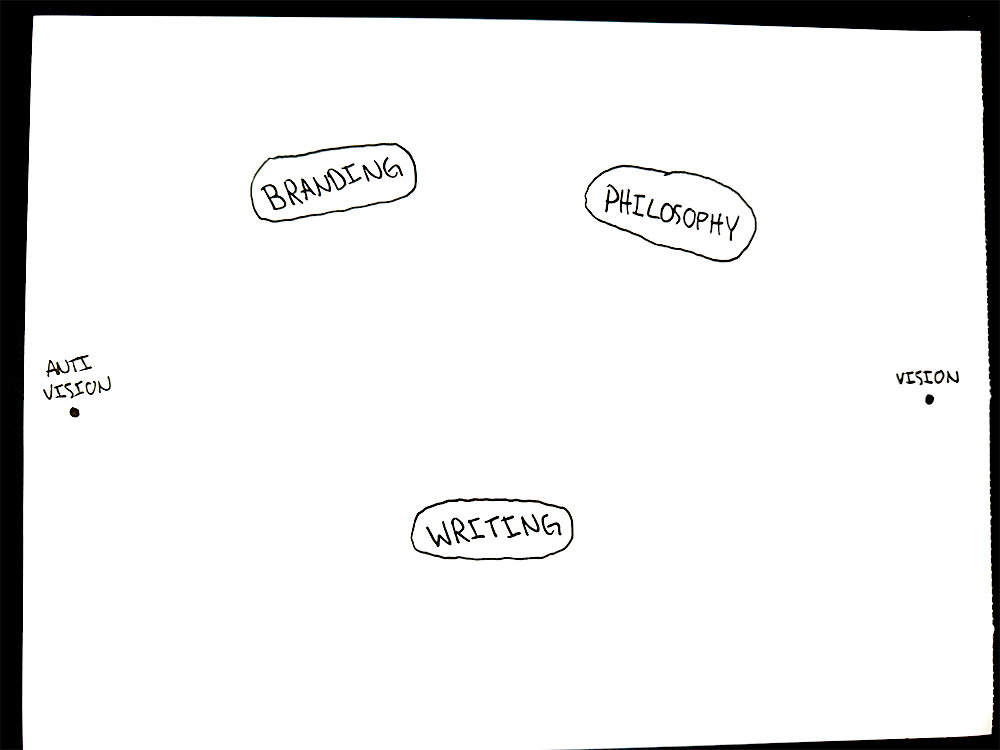
You want to give yourself room to breathe, so don’t make these too narrow or specific. We’ll get to that in future steps.
- If you’re interested in lead generation for service businesses, change that to a more broad “online business.”
- If you’re interested in building content automation agents, change that to “artificial intelligence.”
- If you’re interested in the carnivore diet, change that to “nutrition” or “health”
You want to keep these topics broad because people don’t scroll on social media to learn. Most people scrolling don’t know who you are. They don’t have 99% of the knowledge that you have on your niche topic.
And, it gives your mind room to breathe when determining what to post about.
Notes:
- If you don’t have 3 broad topics, you can add 1 or 2 for now
- If you have no idea what your topics should be, think about what you are curious about and start there (what value-based content do you already read or enjoy?)
- The best topics to choose are those at the intersection of what you deeply care about and what has the potential to make money, although most things have the potential to make money. I guarantee there are already creators monetizing your interests.
3-5 Sub Topics For Each Broad Topic
So far on our content map we have a point A, point B, and 2-3 major “territories.”
Now we need to create the cities.
This part is fairly simple.
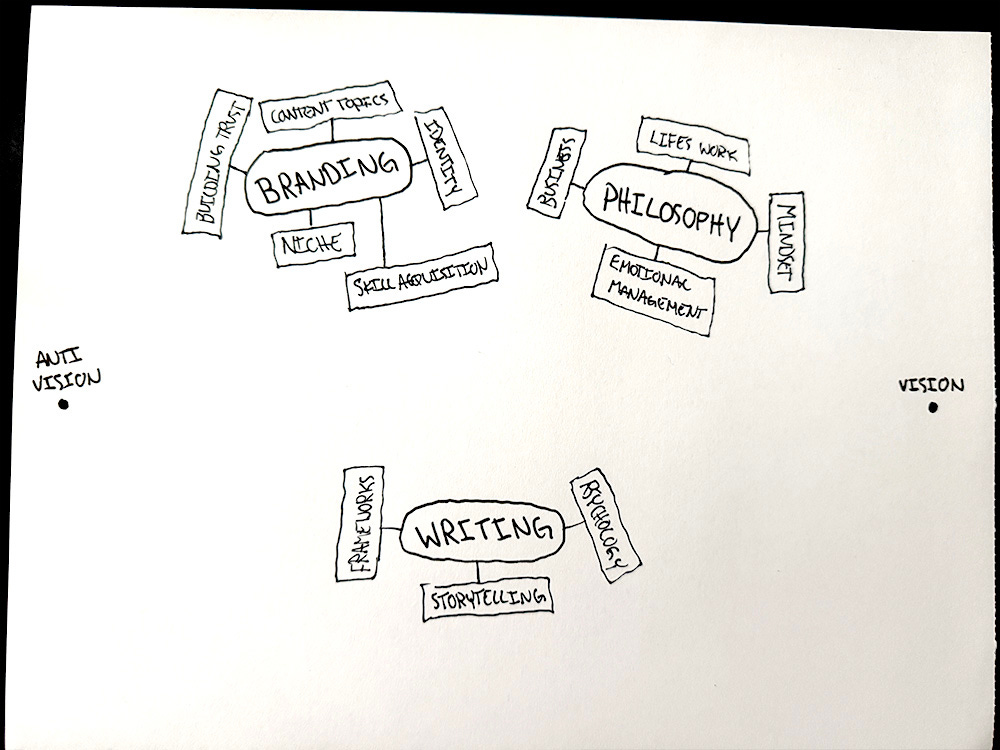
For each broad topic you listed, write out 3-5 more specific sub-topics like you are creating a mind map.
This is where things start becoming more unique to you.
For an interest like fitness, subtopics could be:
- Nutrition
- Lifestyle
- Habits
- Training programs
For an interest like spirituality, subtopics could be:
- Meditation
- Yogic tradition
- Non-duality
- Mental health
For an interest like business, subtopics could be:
- Skill acquisition
- Digital products
- SaaS
- Lead generation
- Sales
You can also ask AI to give you a list of subtopics and then choose the ones that interest you most from that list.
Now our map looks like this:
3-5 Specific Ideas
This is where the real fun comes into play.
So far we have a point A, point B, territories, and cities on our map.
Now we need to give people something to sink their teeth into.
Quests. Resources. Power ups. Traps to avoid. Things like that.
We need to make our topic choices specific, practical, and useful.
Now, for each sub topic, list out 3-5 specific ideas for each.
If you don’t have that much room, choose your favorite sub topics for now. You can always draw these out on new pieces of paper.
Here are the specific ideas I want you to write out:
- Common pain points people experience
- ‘How to’ ideas, like ‘how to practice meditation’
- Lessons you’ve learned about the sub topic
- Why people should care about that topic
- Harsh truths about that topic
- Popular ideas that people talk about often
- Personal opinions about common views of that topic
- Anything else that helps the reader move one step closer to point B on your map
Remember, this is all just a starting point.
This is a map, not the territory.
This is an exercise to help with clarity on where to start.
If it becomes overwhelming or doesn’t help with generating ideas, you are free to drop it and wait for the next lessons.
And, we are still on day 2. We still have a lot to learn about creating content.
A Fun Little Exercise
Many people have difficulty seeing how multiple interests can be nested under one brand.
We’ve partially solved for that by making sure that everything aligns with your mission. Getting from point A to point B.
Take a look at your map.
It’s probably a jumbled mess of topics and ideas that are all over the place.
What I want you to do now is start drawing lines between topics and ideas that connect in some way.
Like how “health” can connect to “how to practice mindfulness” because poor health can absolutely contribute to how stressed or reactive you are.
What you’ll find is that every single topic and idea connect in some way.
This is where idea generation superpowers come into play.
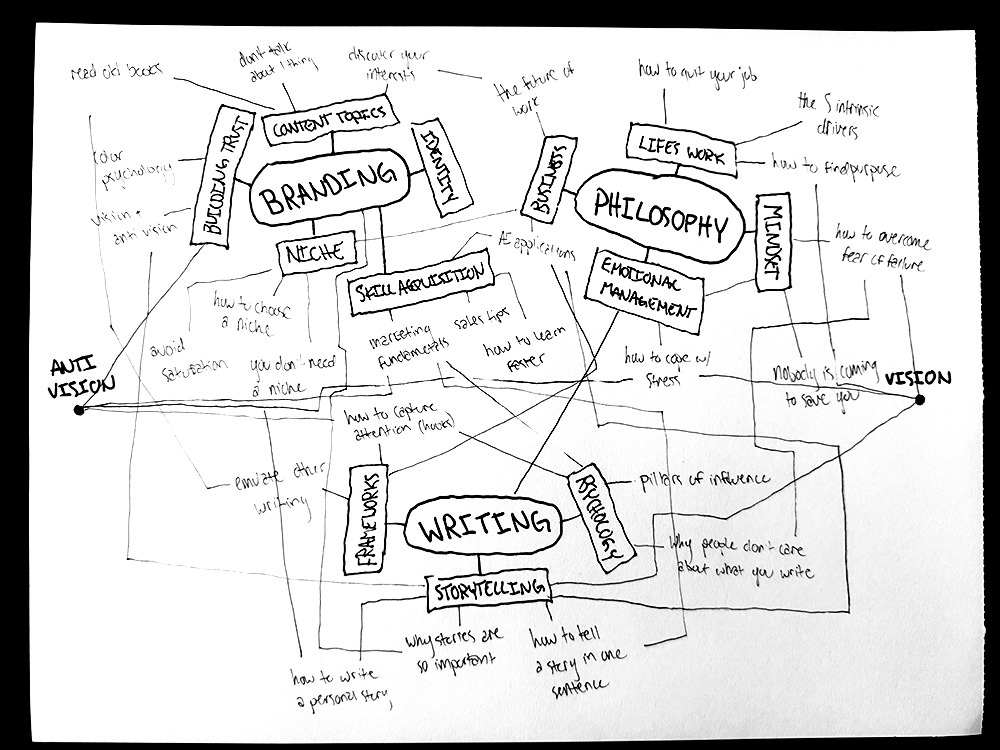
You could technically write down even more content ideas for every single connection, but I’ll spare you that, because the amount of content ideas you can write are nearly infinite.
But, that doesn’t mean they will perform well.
To learn how to make ideas perform well, or practice writing, or how to create a weekly content system, here are more paid posts to read through.
If you’re on desktop, you can view the “Writing Strategies” category here to see all related paid posts.