
03.26 — Dan-Koe
3 Drills To Become A Master At Short-Form Posts
3 Drills To Become A Master At Short-Form Posts
Many have asked for a detailed guide on short-form content.
Tweets, threads, substack notes, and the rest.
And after much deliberation, I’m sorry to say that I can’t really teach that.
But I can give you ways to practice that would have helped me when I was starting out. That way you can develop your own style.
In this post, I’ll give you 3 ways to practice writing.
For each 3 ways, you will write 10 short-form posts.
Meaning, if you take an hour or two to do this, you will have a 2-4 weeks worth of short-form content to post.
I am structuring these practices in a way that encourages you to garner attention and engagement, but without sacrificing your deep ideas or insights.
Even if you don’t want to write on social media, this can become an incredible morning habit to get your creative juices flowing and show you that you do have ideas that are worth posting in public.
With that, let’s begin:
1) Choose 10 Post Structures To Emulate
I believe that any idea can do well.
Because it’s often not about the idea itself, it’s about the delivery.
I can take a silly idea like “walking helps you come up with ideas” and spin it into:
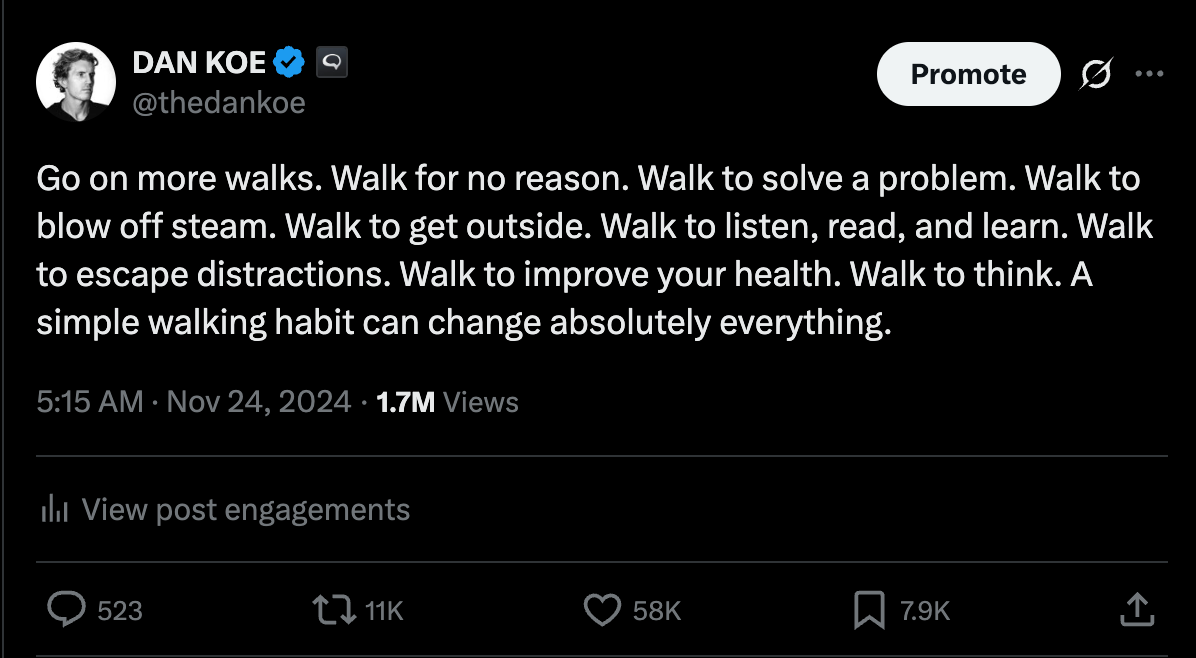
That’s my highest-performing tweet.
I honestly don’t know why it did so well, and it didn’t bear much fruit in terms of followers or sales, but the point stands that if you understand how to structure an idea, you can turn dirt into gold.
So, the first thing I want you to do is create a list of 10 “bad” ideas.
These can be anything…
- Random thoughts that come to mind
- What you find important in life and why
- The basics, pain points, or benefits of your main topics or interests
It could even be something as simple as “I start at my phone too much.”
We will learn how to discover better ideas in the next practices, so stick with me. Right now we’re only focused on practicing writing structures so you understand what makes an idea do well.
Next, open this document and read through the different post structures inside.
These are only a few that I’ve noticed in my own writing that have done well.
I would highly encourage you to start saving post structures that you like as you come across them so you can emulate them.
Now, open up a separate document next to the other one that you’ll write in. You can use Kortex for this or any other notes/writing software.
Here’s what you’re going to do:
1) Pick any of the post structures
2) First, write down why they are compelling.
Take this post as an example:
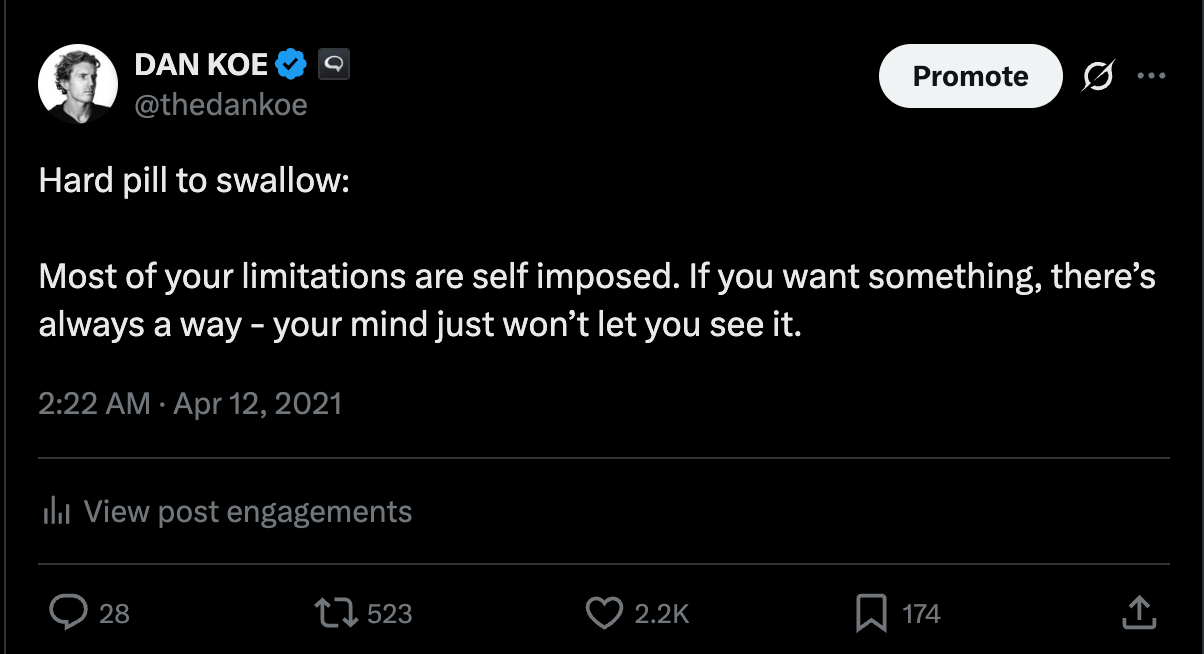
I would write down something like:
- The hook grabs attention by opening a curiosity loop. What’s the hard pill to swallow?
- The sentence after is a harsh truth that isn’t too cliche. It’s novel and makes people stop to think.
- The last sentence implies a transformation. Before = I can’t achieve what I want. After = I can achieve anything. It’s inspiring.
- As a whole, the post is polarizing. Victims won’t agree and will comment about how it is wrong. This increases engagement and filters out people you don’t want in your audience.
When you reverse engineer why posts work, rather than just reading them like a consumer would, you rewire your mind to think in engaging patterns. You learn industry secrets just by asking questions.
3) Last, rewrite your own ideas in that structure (and do this 9 more times)
If we take my silly example of “I stare at my phone too much,” I can turn it into:
You don’t want to admit this:
Your phone gets more attention than your dreams. You convince yourself you don’t have the time, but you’d be surprised how far you can go with a simple shift in focus.
That took me about 5-10 minutes to write, even though it takes 5 seconds to read. Because I had to think and scrap the bad ideas that came to mind first.
Do you see how I didn’t just copy the same “hard pill to swallow” hook? Do you see how my writing wasn’t a basic ass “stop staring at your phone all day?”
When people hear the advice to emulate others’ posts, this is what they mean. Please don’t let me see you giving up on your own creativity by writing something extremely basic or ripping hooks directly.
It should be difficult.
2) Let Good Dopamine Capture Ideas
After you’re done with that drill, here’s what I want you to do:
- Read a book, watch a video, or listen to a podcast (something long-form)
- Hunt for 10 ideas that you could see yourself writing about (and write these down)
- Sit down and attempt to rewrite them in an engaging way (without looking at the post structures from step one)
Doing this without the post structures as training wheels will be more difficult, but it will solidify impactful writing more in your brain.
Now, this step really works when you are clear on what you like to write about online.
It helps to have a mission that you are leading your followers toward, or at least a topic tree with 2-3 main pillars.
When you have those things down and you hunt for ideas in something like a book, dopamine will spurt into your brain, making you think “Ah! That’s an idea I could write about!”
This is where most of my own ideas come from.
If you don’t experience the “dopamine” part at first, don’t worry, you eventually will.
At a bare minimum, force yourself to come away from whatever you read, watch, or listen to with 10 ideas.
If you don’t know what to read/watch/listen to, this next step will help:
3) Swipe Validated Ideas About Your Main Topics
The reason most people don’t grow is that they don’t get in front of enough people.
What most people don’t know is that most creators (within their main topics) talk about the same 5-10 things that lead to all of them growing.
Now, this isn’t a magic bullet. It may or may not work all the time. But if you continue to experiment, you will see occasional bursts of exponential growth. That’s how social growth works, by the way. It’s linear or slow most of the time, then you have huge bursts where you “blow up.”
My YouTube went from 7,000 to 300,000 subscribers over the course of 2-3 months. A year or so of consistency followed by “getting lucky” and a few videos just blowing up because I hit the nail on the head. It was bound to happen.
To the point:
- Write down 5-10 of the creators who are quite popular in your main topics. These don’t have to be celebrities. Just people who are growing quite fast.
- Spend an hour or two researching their highest performing posts. Filter their YouTube videos by most popular. Scroll down their Instagram and look at what posts get much more engagement than their others. Pay attention to ideas they post over and over again.
- Write these ideas down somewhere safe.
- Then, do what you did in step 1: use them as structures and attempt to rewrite them.
When you start your writing with a validated idea in mind, your chances of doing well increase quite substantially.
If a topic is doing very well right now, write your own version of it.
That’s really all that this comes down to:
Consistently writing ideas that have a high potential for engagement.
Of course, there’s more to the story, but I’ll save that for another post.
Your posts are only one piece of the puzzle, and most people fail not because their ideas are bad, but because they expect the algorithm to make them famous.
Smart creators make friends with and leverage the audiences of people who are just slightly ahead of them.
But as I said, that’s for another time.
I hope this helped and thanks for reading.